Thursday, August 1, 2013

New projects with pharmacy and hospital visits mixed in

For the majority of the week beginning on 7/12, we continued our work in the storage room of the Monte Plata clinic. It was more or less putting the final touches on our project.  All the signs for the various areas are clearly displaced. We continued making more “ofertas” or special offers in mini-bags for the pharmacy. According to Jahiri, the staff member in the pharmacy, they sold very quickly. She even says patients still inquire about them after they have run out.  Since there are many ofertas in the storage room, the key will be coordinating how more ofertas can be brought into the pharmacy.  Ofertas have been a great success and I hope it continues. We were told by Don Teo, the person in charge of the almacen, that the storage room will look the same once we return and visit the D.R. I will hold him to that!

Collage of completed Project Hope Monte Plata Clinic storage room. Top left: Medications. The shelves run across most of the room and acts as a divider to the back area. Top right: Syringes, Dentistry, Sonography, Gynecology and nursing. Bottom left: cleaning supplies. Bottom middle: Many Bandaids! Bottom right: miscacllaneous items with made ofertas for August to be given as gifts for women and children who complete all requirements of the 5 Star Program.
 Another potential problem that I looked into was the VCR player.  I thought I had seen the last of them!  There were several old educational videos available at the community health room.  However, many of them were unplayable due the condition of the VCR.  I was able to clean the spinning rim or the more technically term is the rotating head drum.  This was something my uncle taught me how to do when I was a little boy in Cameroon.  It’s done simply by opening the VCR and cleaning the drum thoroughly around with alcohol. Unfortunately, only one VHS tape on dengue education was playable. Considering that VCRs are less prevalent and DVDs are the norm, the clinic will be better served with DVD player.  While patients are waiting to be seen in the waiting area, educational videos can be shown to the patients. I believe Liz and Jillian were looking online to see if any international organizations, such as PAHO or UNICEF, had some Spanish educational videos that could be utilized for the clinic.  Yet another project!

Here I am removing the VCR from the VCR stand below the TV. This is what faces the patients in the waiting area everyday.  During the day, patients mostly watch spanish soap operas.

 On the Wednesday (7/17), Jillian and I had the chance to visit the Padre Martin pharmacy which was established by the Order of Malta.  According to their website, the Order of Malta are a “lay religious Order, traditionally of military, chilvarous, noble nature”.  Their headquarters are in Rome, Italy.  They provide many essential medications to the public at a relatively low price and they are constantly busy. Due to the pharmacy’s religious affiliation, there’s hardly any family planning products available to the public.  Jillian and I had the opportunity to inquire about the medications that can be sold without a doctor’s authorization. We were just simply told that there is such a differentiation.  My understanding from the response we received was that they must have a list visible to all the workers in the pharmacy that helps them distinguish between prescriptions and non-prescription medications. Some examples of medications that require a prescription are: pregabalin, montelukast, and acido mefenamico.  These medications are marketed in the United States as Lyrica, Singulair and Ponstel respectively.  We were told there was a pharmacist that works there but she wasn't present when we visited.


When a particular medication isn't available at the Monte Plata clinic, patients typically come here. 

Ponstel (Mefenamic Acid): Non steroidal anti-inflammatory indicated for menstrual cramps. Singulair (Montelukast): mostly for Asthma. Lyrica (pregabalin): for nerve and muscle pain

Further into town, we visited the sub-center hospital.  It serves as the main hospital for Monte Plata municipality of about 57 thousand plus people.  Monte Plata is also the name of one of the 31 provinces present in the Dominican. Essentially, the sub-center is in Monte Plata, Monte Plata.  This is true of the other regions of the Dominican in case you aren't confused already.  It was makeshift hospital considering it wasn't originally designed to be a hospital.  In fact, it was scheduled to be demolished. 

When we visited, the main lobby was filled with patients sitting and waiting to the seen. On the right side was the pediatric wing of the hospital that had an enclosed hallway that led to small room with 2 sick patients on hospital beds in the corner of the room.  Further down was an even smaller room for procedures.  The main floor also included: laboratory room, nursing, vaccinations, pediatrics, surgery lab, and an administrative room. The inpatient rooms were upstairs along with: psychiatry, HIV counseling and delivery rooms for expecting mothers. The concern with the setup of the hospital was that both inpatient and delivery rooms were upstairs because such patients would have the most trouble getting upstairs.  Moreover, there are no elevators.  As mentioned before, this could be due to the fact that the hospital had to be setup as is since it was not originally designed to function as a hospital. The benefit of the upstairs area does provide the benefit of added privacy and confidentiality.  As a side note, we later found out that a new hospital Monte Plata province is being built. It will be able to accommodate over 200 thousand people. The 120 inpatient bed hospital will also be able to perform surgeries that usually had to be done in Santo Domingo.  Some of its other features include: laboratory and diagnostic testing, 3 operating rooms, and 15 offices for various medical specialties.   


The director of the sub-center was very gracious in giving us a tour of hospital. He asked if we could spend some time in the hospital. Unfortunately, we were unable to due to our other projects at the Monte Plata clinic.
We then went across the street to visit the “Farmacia Santo Cristo.”  It’s a much smaller pharmacy than Padre Martin but we were able to find the first birth control pill in Monte Plata.  It was actually plan B one step or “PostDay 1” to be used only as an emergency contraceptive and taken within 72 hours of unprotected sex.  It costs 200 pesos (or $5) but it is not covered by Senasa.  “Seguro Nacional de Salud” (SENASA) or National Health Insurance is one of the Dominican Republic’s major health insurance providers. Again, the person running the pharmacy was someone with no pharmacy education background. It’s unfortunate that many popular pharmacies can not afford to have a pharmacist who can counsel patients on proper medication administration, storage, or provide other pertinent information. The business model dictates that patients may purchase what they desire without the benefit of having a pharmacist on hand. Moreover, a vendor cannot be forced to give instructions to patients or else he or she might lose a sale.

The lady we spoke with at the Santo Cristo pharmacy was very informative and knowledgable about some medications despite not having any pharmacy training

 On Friday (7/19), we had the chance to teach ‘the teach back method’ to the staff members of the clinic. I had been creating and preparing a PowerPoint presentation on the teach back method. Jillian and I created an educational document for patients that explains what the teach back method is and how they can best benefit from it. This will be hung on the walls and on the doors of community health room, nurses area and doctor's offices. We also created a document for doctors that includes important questions that should be asked to patients upon completion of the consultation. This document can help doctors as well because it can serve as a way of reminders doctors to teach relay information they may have forgotten to give.  The photo below on the left is for patients and one on the right is for the doctors.


We set up an ideal time in the afternoon….an hour before the clinic closes on Friday at 4pm when there are hardly any patients waiting to be seen.  With Liz’s help translating, Jillian and I were able to talk and discuss the teach back method with the staff.  The teach back method is essentially having the patient repeat back what said in order to confirm patient understanding.  This is something that is stressed to us in pharmacy school in order to improve patient compliance and health literacy.  The staff was very responsive and had much to add to the discussion. Abdias was also able to add much to the discussion given his medical background and enthusiastic way explaining concepts. It's always entertaining! Even though there is the potential for unreceptive patients or time constraints with doctors, they all recognize that it’s an important method and that there are some communication challenges that the teach back method can help alleviate.

'Teach back' presentation and discussion


Las Terrenas: Weekend Getaway!


Birthday Weekend on the North Coast

(7/12-7/14)

One of the many questions I was asked before going to the DR was: Are you going to go to the beach?! I am glad to finally answer that question with a definite YES! Teresa allowed us a 3-day weekend to spend on the north coast along the Samana Peninsula. We went to Las Terrenas! This was an extra special weekend because it was Liz’s birthday on Friday, July 12th!

The trip started smoothly. We took a gua-gua (van) from Monte Plata to the main highway, which runs north and south. This was about a 25-minute ride. The gua-gua technically had about 8 seats in it...but we squeezed about 18 people in it. That is considered normal for the gua-guas. People often hang out the open side door.
The ride to the highway and then to Samana. The top two pictures are the first gua-gua, it was packed!

Once we made it to the highway, we had to wait for another gua-gua to take us north to Las Terrenas. This is where it got a little tricky. Buses do not run on a schedule like they do in the states. We could not look up times online to see when the buses were going by Monte Plata, we just had to wait and hope it went by while we were sitting there. Luckily we had Miguel, staff member from the clinic, with us to help us catch the right gua-gua.

We waited about 20 minutes for the next gua-gua. This gua-gua was much nicer. It had seats much like a normal bus in the States and had air conditioning! We all got very excited anytime we had A/C. This gua-gua ride was smooth. We went up through the mountains and past a lot of fields of rice patties. We also passed several palm tree plantations.

After about 2 hours, we had arrived in Samana. Little did we know, Las Terrenas and Samana were not technically the same place. We were supposed to meet up with our host in front of the cemetery in Las Terrenas, so we had a motorconcho take us to the “cemetery”. After several minutes of waiting, looking, and confusing cell phone conversations, we realized that Las Terrenas was a different city and about 45 minutes away. We were at the cemetery in Samana and had taken the wrong gua-gua! Luckily there were still gua-guas running from Samana to Las Terrenas, though we were originally told that there were no more gua-guas going there and we were going to have to shell out $1200 pesos ($30) to take a taxi. The gua-gua was another little van-like gua-gua and only cost us $100 pesos each ($2.50).
Our mini trip in Samana. The first picture is the motorconcho that we took to the "wrong cemetery".  There were tons of motorcyclists at the bus stop, they are the Dominican version of taxis. The last pictures are of the final gua-gua that took us to Las Terrenas

Our first day in Las Terrenas. The first pictures is the house we stayed in for the weekend. Next is a picture of my leg. I was eaten alive on one of the gua-guas! I still have not figured out what type of critter bit me! I know it wasn't mosquitos, bed bugs, or fleas. We spent the first day trying local cuisine, lounging on the beach, and watching the sunset before we went to dinner for Liz's birthday.
After about 3 hours of travel, we had finally made it to the beautiful town of Las Terrenas, and I mean BEAUTIFUL! The coast was line was pristine! The most gorgeous crystal blue water that any of us had ever seen! We spent the weekend with a friend of a friend of a friend of Terasa’s. The lady was French and had lived in Las Terrenas for 15 years. Her Spanish accent was very unique! She and Derek mostly spoke French together, but every once in a while she would switch to Spanish mid sentence. This was quite amusing to Derek and Liz! She was kind enough to show us around the town, recommend good restaurants, take us to the beach, and of course, show us the French bakery! We spent most of the weekend lounging on the beach, which resulted in beautiful tans…just kidding! We all got quite sun burnt despite our continuous lathering of sunscreen. This town was filled with people from all over the world. We met Englishmen, Cubans, French, Italians, Americans, and more! This was a beautiful beach town that was not too touristy. I would love to visit again!
THE BEACH!!! It was absolutely gorgeous!
On our last day, our host drove us around town. We saw many small shops, fruit stands, pharmacies, hospitals and restaurants. Interestingly, the hospital was closed when we drove by it! Also, we went in a French pharmacy which had a lot of "natural" remedies. Derek and I were not impressed. 

Organizing the Monte Plata Almacén or Storage room - Week of 7/8

The big project that has taken the majority of our time in the Monte Plata clinic has been the almacén or storage room. Each of the Project Hope clinics in the Dominican has a storage room.  The new clinic in Haina that is set for groundbreaking in mid-september will also be equipped with one.  They are utilized for storing: donated medications, ordered medications, supplies, documents and equipment. 

When we were first introduced into the storage room, there were lots of boxes of dispersed throughout the room.  The center of the room had numerous boxes on the floor that made it difficult to move through the room and identify what items were inside the boxes. Jillian, Liz, Abdias and I have been working tirelessly in the storage room to create a sustainable organizational structure that can be maintained for the foreseeable future. The Monte Plata almacén is divided into two by the medication shelf that runs through most of the middle of the storage room. We cleared the many piles of boxes in the back area. Thanks to Liz, new labels have been made for donated medications as well as medications that are ordered by the clinic via Project Hope. There are now also signs for gynecology, dentistry, cleaning supplies, medical supplies, medications, and eventually nursing as well. There is a new shelf that will soon be built and then utilized specifically for nursing. Our goal was to remove everything from the boxes so the staff can recognize what is at their disposal. The majority of the boxes have been emptied and whose contents have been placed on shelves or placed in a mini-bag with other items to be sold at the pharmacy. We called the mini-bags or special offers, “ofertas”. Examples include: body wash, sunblock, toothbrushes, acne wash and an insane amount of bandages! One example of a type of ofertas we made included: two toothbrushes, listerine mouth wash and bandages of course! 

The top two pictures show the boxes in the middle of the room that we eventually cleared and assigned its items to a particular area. The picture on the top left also shows how some medication shelves were cleared for re-organization.The next two show Jillian, Liz and I making 'ofertas' for patients to be sold at the pharmacy. The last two are of me taping up a new sign for the gloves section and Jillian helping to clean the door into the almacén

Having an assortment of items sold at pharmacy at a inexpensive price allows customers to recognize the care the clinic shows and gives them an incentive to return to the clinic for health related checkups or follow-ups.  Many of the boxes of toothbrushes, bandages, and skin care products were underutilized or unrecognized. Now the storage is less cluttered and more efficient in terms of how items flow in and out of the almacén. The future goal is to always have the storage room organized and to make sure new items have a set location.

Santo Domingo

The next four days of our trip were spent in Santo Domingo, the capital of the DR. We drove through many small towns, down many small (broken-down) roads, and past many fields of green, then all of a sudden we were in a city! Within a few minutes of being inside the city limits, we were instantly surrounded by tall buildings, apartments, billboards, street venders, people, cars, and traffic! Santo Domingo is a large, metropolitan city much like what we would picture in the U.S. We quickly learned that all of the traffic laws that we obey in the states are simply “suggestions” here. Drivers cut other cars off, turn left or right from the middle lane, drive in two lanes, park in the middle of the road, reverse on highways, go through red lights, back out into moving traffic, honk for fun, come within inches of the pedestrians on the side of the road, pack 15+ people in a 8 person van, and often stop just inches away from the car in front of them. Funny thing is, by the end of the stay we were pretty much used to it! That is how everyone drives down here and they are all very good at it! We never once saw an accident, though we saw many close calls! The main different between Santo Domingo and a city in the U.S. is the number of motorcyclists. The majority of people ride small, rickety motorcycles. Motorcyclists weave in and out of traffic, go through traffic lights whenever they please, drive on the other side of the road and often don’t wear helmets. Needless to say, driving (or being a passenger) was an exciting experience!

On Thursday (7/4), our first stop was the site for the new clinic. Project HOPE is building a new medical clinic in Haina. Haina is another subdivision of Santo Domingo and will have a fairly large patient population. A very wealthy landowner donated the land. The land was donated over three years ago, but there was a property battle with several small business owners who has squatted on the land. They claimed they were told that they could use the land by the city and it took a lot of time and money to convince them to move. The plot of land is currently a field of weeds and plants. Project HOPE had originally planned on breaking ground on August 6th, but the date has since been changed to mid September.

The land for the Haina clinic.
After our visit to Haina, we went to the Herrera clinic. This was the first clinic established by Project HOPE in the DR. The clinic is almost the exact same layout as the Monte Plata clinic. We were given a tour of the clinic and met the majority of the staff members. I think there are a few more people working at this clinic because it sees a larger patient population. This clinic is busy almost all days of the week. Monte Plata has its slow and busy days throughout the week.

After our tour, we sat in on a staff meeting, a very cramped staff meeting. Teresa organized an impromptu meeting for Derek, Liz and me. We fit about 15 people in a very small office. In this clinic, the staff members are divided into four groups. Each group is responsible for discussing and improving a different aspect of the clinic. Unfortunately, I am not sure exactly what each group’s specific assignment was, but they were along the lines of promoting health education, staff development and several other topics. Each week, these four groups meet individually and then collectively to discuss any changes or observations that they have seen.
 
Herrera clinic
After a long day of traveling and seeing the clinics, we retired to our hostel in the Zona Colonial. Zona Colonial is a very old part of Santo Domingo. This is where Christopher Columbus first landed when he was in search of the Americas. Our hostel was very nice. We had our own bathroom and breakfast was cooked for us each morning. It even had air conditioning! After settling in, Derek, Liz, Dana and I went to Hard Rock Café for a little American cuisine. After all, it was the 4th of July.
Hostal Dominico Mundial
The next day (7/5), we all went to a conference hosted by the Ministry of Public health. This was a meeting for all of Zone 7. Santo Domingo is divided into zones for the purpose of health care. This meeting was about the importance of clean water. Project HOPE has a good relationship with the Ministry of Public Health and we wanted to be there to show support for their event. Both Project HOPE and the Ministry of Public Health help each other get medications and vaccines for each other. The conference was scheduled to start at about 8am. We arrived a little before 9am, and it still had not started. This is where we learned about “Dominican time”. Dominican time is simple: if something starts at 8am, and you get there by 10am, you are still on time.  We were all waiting for the Minister of Public Health to arrive to give a speech. While waiting, we were all introduced to many directors, doctors, nurses, and other health care organizations from the Santo Domingo area. Everyone wore t-shirts to show support for their organization or cause. By 10am, the Minister still hadn’t shown up. He was late in Teresa’s eyes, so we left. She said we made a point of being there on time so it was his loss especially since we waited for over an hour. We found out that the Minister never ended up showing. Apparently he had another conference that day and went there first, but never made it to the one for Zone 7.
Ministry of Public Health conference (MSP: Ministerio de Salud Publica)
We went back to the clinic to follow the doctors for a few hours. I was able to follow an OB-GYN. He was very nice and spoke English well. I was able to see several pap smears, pregnancy evaluations, and general consults. The doctor showed me how he did a pap smear and told me that I could do the next one! I tried to explain to him that I just do medications, but he still insisted I give it a try. I nicely asked him to do the next one so I could see how he does it one more time, and told him I would do the next patient. Luckily, no other patients came in for a pap smear before I had to go! But it would have been an interesting experience had a patient come in! Derek spent some time with a pediatrician and saw several small children. I don’t think he was asked to examine any of the children!

Later that afternoon, Teresa invited two good friends of hers to meet with us. Their names are Ruben and Anell. They started an organization called Project Hearts. This organization is dedicated to improving different aspects of rural, needy communities. Their projects have included: building bathrooms for schools, installing water filters, repairing homes, providing food to needy families, and much more. Ruben started this non-profit organization in 2011. He is a Dominican native who immigrated to the States when he was a teenager. He went to school in the states and eventually went on to study in the seminary. He wanted to be a monk or a priest. Later in life, he returned to the Dominican and decided that he was needed here and could provide great service to many people who need it. Anell is a civil engineer. He got his degree and was not able to find good work so he was hired by Project HOPE to help them with office work. After working for Project HOPE for a year, he was introduced to Ruben and quickly found the perfect career for him. He has been working with Ruben ever since. These two men were extraordinary inspirations to Derek and I. They brought us both to tears while listening to their stories and reflecting on our own lives. They are amazing people. The most important thing I took away from them was importance of helping people help themselves. You can give someone money or food to help them at the present, but giving them that stuff does not help them in the long run, they will keep coming back for more. But if you help this person get a better education or have him or her work towards a goal, you are helping this person help him or herself by bettering him or her as a person.

That evening, Teresa took us all out to dinner to a restaurant called El Conuco. This restaurant not only had good food, but it also had live music and dancing! Our entire table had a wonderful night of dancing and eating! Each one of us got up and did a little meringue, salsa and bachata! It was a fantastic end to a long, hard week!
El Conuco! We danced the night away!


Top left: Statue of Christopher Columbus. Top Right:  Catedral Santa Maria la Menor, the oldest cathedral in the Americas. The next three are pictures from within the Museo Las Casas Reales. The last picture is maduros (fried sweet plantains). We loved them so much that we learned how to make them!
Liz, Derek and I spent the weekend in Santo Domingo. We took the time to explore the Zona Colonial. We went to several museums, cathedrals, restaurants and craft shows. The first (oldest) cathedral of the Americas is located right in the Zona Colonial. It was built in the 1500’s and it was magnificent! One evening we went to a small bar/restaurant called Casa Teatro and saw some live music. It was a one-man show, but he sure was good! On Sunday, the three of us went to another part of Santo Domingo and explored the Botanical Garden. This garden encompasses over 400 acres of land and is home to plants from all over the world. We spent hours exploring the garden and appreciating the beauty of nature. We saw a sign for a medicinal garden and got really excited…but sadly the signs were not accurate or point to the wrong directions because we could not find any medicinal plants.
More pictures from Santo Domingo. A craft stand, the cathedral at night, live music at the Casa de teatro, Liz and I at dinner, a very large statue that did not have a posted name, and a view of the channel/ocean.
Some fun at the Botanical Garden

Tuesday, July 9, 2013

Getting things moving!

Sorry for the length of the blog in advance but much has transpired since the last one!

On Sunday morning (6/30), I was awakened by the sound of roosters and the locals on motor bikes and horses as they passed by a path near my bedroom window. For breakfast, I decided to try the cereal that is available here for us. It’s called ‘Fitness’. The cereal in the states that comes closest to it would have to be Oatmeal crisp.  It tasted great but I am not quite sure I if its consumption made me lose many pounds.  My laundry was then hung out to dry from the machine wash the day before. The Dominican heat was able to dry them in under an hour! The initial plan of the day was to visit Los Haitises National Park, which is about 20 minutes from Monte Plata. However, we were uncertain as to what routes the local buses or “Gua Guas” would be taking and how many stops would have to be made before we reached Los Haitises.  We decided to save it for a rainy day. On second thought, that idiom doesn't actually work considering the tropical weather. It will be saved for when mother nature cooperates.  

Instead of staying in for the whole day, I decided to venture into the stadium across the street from our house. Within the roofed gymnasium there is a basketball court, a volleyball court and an area for taekwondo classes. The entire grounds also consists of a baseball field.  Jillian and I have yet to see a game played there. When I entered the gymnasium, I was lucky enough to find someone who spoke some English. I was then able to play some soccer and basketball with the local children who were mostly of high school age. School is out here in the Dominican for the typical eight week long summer break which began June. As a result, the gymnasium is always full throughout the way and it makes for a popular hangout spot for the children.

Gynamasium. It's equipped with basketball court, volleyball court and an area for taekwondo classes
Estadio de Baseball - Isidro Santana (PAPO)

When Monday (7/1/13) arrived, we had come upon the start of new work week here in Monte Plata with the added prospect of staying in Santo Domingo for few days at the end of the week! We also learned that Dana Fitzsimmons and Teresa Narvaez were going to be joining us on Tuesday.  Teresa is the Project Hope country coordinator for the Dominican Republic. Dana Fitzsimmons, as mentioned in the other blogs, is pharmacist based in Washington D.C who will be guiding our activities here in Monte Plata.  For the day, Jillian was able to observe the nurse’s station. She’s making a synopsis of her experiences for this blog.  I went into more detail about the 5 Star program with Abdias.  The main health initiative that is being emphasized in Monte Plata clinic is exclusive breastfeeding for the first 6 months. Breastfeeding is not only free but breast milk provides the best food for optimal growth. The concern here in Monte Plata and other places around the world is that some women stop after a few months. When that happens, there is an increased risk of babies drinking contaminated water and using unsanitary feeding bottles and therefore increasing the risk of infant illness and mortality. If anyone would like more information, feel free to let me know.

From left to right: Abdias, Teresa, Don Ceasar, Liz, Jillian, Dana


Later in the day, I also had the opportunity to shadow a general doctor or family doc. Considering that there are far fewer patients in the afternoon, I was only able to observe one patient.
On Tuesday (7/2/13), Dana and Teresa arrived to greet us in the morning. “Mr. Monte Plata”, Don Ceasar, was also kind enough to greet us and welcome us to Monte Plata. He does a lot of philanthropic work in the community and has been responsible for much of the construction work and development in Monte Plata. Many of his sons are medical doctors. Despite the reverence and respect he has in the community, he does not ask for any special favors. He mentioned that he prefers to give back while he’s alive so he can appreciate the gratitude of giving. The one quote he gave to us, albeit translated, that will stick with me is “Everything is done with feeling.” I think that phrase describes much of what the Dominican people are like.  They are very friendly, sensual, easy going and have an open way of life. Despite the poor conditions that some live in, they still express “le joie de vivre.”. He even offered us coffee and the opportunity to meet his grandchildren. We all thanked him for taking the time to pay us a visit and we told him we would take the time to stop by for some coffee.


This is Orlando showing us the list of medications that were used within the last month. The plan is to have a running list of all the medications including directions for use, side effects and monitoring parameters.  Much of how medications are ordered was also discussed here.  Orlando is the program coordinator for the Monte Plata clinic.

During Dana's reintroduction to the Monte Plata clinic, he hugged many familiar faces that he’d known from his time in the D.R. starting in 2008.  When he can, he tries to make yearly visits to see the progress that is being made in the clinics in the D.R. Dana actually started a program in the D.R. Project Hope clinics called ‘Preguntame 3’ or ‘Ask me 3 questions’.  The questions serve as a verification  system to make sure the patients are getting the necessary information in order to receive adequate care. They questions are: what is my major problem?, what do I need to do? and why is it important for me to do this?” I’m sure Dana feels great pleasure and pride to be able to return to the D.R. and see that the program he created years ago remains sustainable. Afterwards, Dana, Jillian and I talked about the potential projects we could pursue in the remaining 3 weeks we have left in Monte Plata. They are: the teach back method, continuity of care, developing key communication strategies, translations, identifying cultural differences in the area, developing a marketing plan for 5 star program……and many more!

The top 4 pictures are of us in the "community" office.  The bottom two are of us in the storage room which houses a combination of donated meds and those on the inventory. The goal here was discussing how to arrange all the medications stored here more efficiently.  That's the project for us!
My focus will be on assessing and implementing a training program for the nurses about the teach back method.  The teach back method is used not as a way of checking for a patient’s knowledge, but rather their understanding or comprehension.  For example, if a doctor writes a prescription for an Amoxicillin Suspension for a 3 month old baby, the doctor or nurse should ask the baby’s caretaker to repeat back the instructions that he or she said so the baby gets the best treatment.  In the Monte Plata clinic, the nurses give the first dose of a medication on site.  This is a fantastic practice because this allows the clinic to mix the antibiotic suspension, which can be a complicated process for a caretaker at home.  Moreover, it can be an added challenge for a baby’s caretaker to find purified water to reconstitute the medication.  The implementation of the teach back method can help save lives and improve healthcare. The extent of my project will be towards the nursing staff in the “community” office. The “community” office is an area in the clinic where dosing labels are made, dosing instructions are explained and the first dose is administered if need be.  The goal is the idea of ‘training the trainers’. In order words, the trained nurses can train other clinical staff and make the educational process sustainable. If anyone wants to know more about my potential project, let me know.

Assessing the workflow and identifying potential ‘holdups’ in care are important in evaluating how well the clinic is running. When entering the clinic, the patient registers at the front desk. The receptionist gathers their insurance information and they are given a number for when they will be called. Before the patients are seen there is a morning prayer given the fact that the D.R is primarily Roman Catholic.  As the patients are waiting to be seen, there are morning “charlas” or chats. There is a different health topic on different days, so depending on when patients come into the clinic they might not get information on a particular topic that may apply to him or her. The daily chats include health information on AIDS/HIV, breastfeeding, and the 5-Star program to name a few. The challenge is making sure the patients are engaged in the discussion and trying to establish one-on-one time with patients so individual educational needs are met. 

After leaving the clinic, Jillian and I walked around town with Dana. We all had the chance to visit a nearby pharmacy.  Pharmacies in the D.R. function more as drug dispensaries than the multifunction pharmacies seen in the United States. “Farmacia” as they are called are solely drug vendors without an pharmacist, pharmacy intern or technician who has some drug training.  Many prescription only medications found in the United States like Lisinopril are available in the D.R. without a prescription. We haven't yet had the chance to see the popular pharmacies available in hospitals. It would be interesting to note the differences. They, for example, would have the ability to purchase and dispense controlled medications such as Morphine Sulfate.

"Farmacia" in D.R.
In the evening, Teresa played some Dominican music in the guest house.  Dominican music consists of the merengue, salsa and bachata.  The music requires a lot quick leg shifting and hip movement. Having grown up dancing to Cameroonian music such as Makossa, I could see that Dominican Music has some African roots.  Dana, Jillian, Teresa and I all danced to the music.  It was great to dance to latin music for the first time.  I knew I would get to show off my average dance moves!

Jillian and I dancing to some Merengue with Teresa! It's pretty obvious I have no idea what I'm going but I got it going!


Our Dinner for the evening was Pasta, mixed veges and of course the ever delicious "plantanos fritos" or fried plantains.


>Adios until the next one!


Sunday, June 30, 2013

First Days on the Job


Thursday (6/27) was our first day at the clinic, sort of. The clinic primarily a maternal and childhood clinic. This clinic offers many services including: vaccinations, HIV testing/counseling, OB-GYN, pediatrics, family medicine, dental care and sonograms. The clinic promotes the 5 Star program and IMCI (Integrated Management of Childhood Illness). 

The 5 Star program is for pregnant mothers and infants up to 60 months (5 years old). Each stage of the program awards up to 5 stars to the mother or child. For instance, the mother first enters the program while she is pregnant. She can earn her 5 stars for getting all necessary vaccines, HIV testing/counseling, doing lab work, visiting the doctor six times, and bringing the newborn within 7 days of birth. After birth, the stars are now awarded to the baby during the different stages. The stages are 0-6 months, 7-12 months, 13-23 months, and 2-5 years old. Within each stage the baby is awarded stars for doctors visits, vaccinations, growth and weight progression, breast-feeding, and other age-specific factors. The program is structured in a way that ensures the mother and child are receiving adequate healthcare management from pregnancy to early childhood.  Health literacy remains an area of improvement in the DR.  One of this program’s goal is empowerment of women by progressing health literacy in all mothers.

The 5 Star program
IMCI is a program that was designed by the WHO and UNICEF in 1995 to provide a comprehensive algorithm for the diagnosis and treatment of 5 of most common diseases that cause illness and death in children under 5 years old. These diseases include: pneumonia, diarrhea, malaria, measles and malnutrition. The IMCI aims to improve childhood illness by integrating aspects of nutrition education, vaccinations, and other influential factors including maternal health. The ultimate goal of the program is to reduce mortality, frequency and severity of the illness, by integrating treatment and prevention strategies, to ultimately contribute to the improved health and development of children.

Okay, now that we all understand a little more about the clinic, I can now tell you a little more about what Derek and I have been doing! We live in a 3-bedroom, 2 bathroom house on the grounds of the clinic. The clinic and the guesthouse are surrounded by a 5-foot fence and have a guard on duty 24/7 (that one is for you, Mom!). The house has running water, electricity, WIRELESS internet (thank you to the volunteers who were here a few weeks before us) and ceiling fans. You many have noticed I did not mention air conditioning, but surprisingly the fans keep it fairly cool inside.

Home Sweet Home! The top right picture shows how close our house is to the clinic! We have a full kitchen, cozy living room and quaint dining room! Bottom right is Derek's room complete with a futon and a bright yellow mosquito net! Mosquito net = must have in DR!
We have a roommate! Her name is Liz, she is a recent graduate from Macaulay Honors College at the City College of New York and is participating in a program called the Jeannette K. Watson Fellowship. She arrived June 8th and is staying for 10 weeks! She is fluent in Spanish and Derek and I are VERY appreciative of it! She has been a great help orienting us to both the clinic and the city of Monte Plata in general. Liz, Abdias (the medical student from Haiti), Derek and I spend a lot of time together, four best friends!

Derek, Liz and I have housekeeper who cooks for us. Her name is Aude and she is a fantastic chef! She has made us a variety of foods and always makes fresh squeezed juices for us! So far, our favorite is her homemade limeade! We are very grateful for her generosity.

Aude prepared two wonderful lunches for us! Top left was chicken with peppers and onions, vegetable salad, brown rice and beans, and a ceviche peppers and onions. Our next lunch was pork chops with peppers and onions, rice, beens,   and fried cauliflower...this was AMAZING! Fruit is abundant here! We always have bananas, mangos, passion fruit, papaya, apples and plantains!
So now for the clinic! As I mentioned before, Thursday was our first day at the clinic, sort of. Derek, Liz and I were up and ready to head over to the clinic at 8am. We were met by Abdias shortly before we left and he informed us that we were to wait at the house for Teresa, the Project Hope coordinator from Santo Domingo. My impression was that she was going to be there shortly, but in reality she came at about lunchtime. So needless to day, our first day at the clinic was not so much in the clinic. When Teresa arrived, she had an American doctor with her. He was interested in volunteering at the Project Hope clinics in the DR.  Teresa gave all of us an introduction to Project Hope and the clinic.

After lunch, Liz and Abdias gave us the official tour of the clinic. It is small, but always bustling with people! After our tour, we met with Dr. Mansueto, a pediatrician.  She began going over the IMCI algorithm with us in great detail. Luckily we had Liz and Abdias to help translate. The algorithm consists of defining the illness, duration, signs and symptoms, classification, treatment, medication, and a follow-up visit. We all ‘roll played’ being the doctor/interviewer and mother/father of the child.  It was surprisingly easy to do. This algorithm was actually designed to be used by anyone, not just a health professional. For instance, a mother can maneuver through it at home to determine the next step in helping her baby, whether it be bring him/her in to see the doctor or to give some acetaminophen to help reduce a fever.

Derek, Liz and I practicing using the IMCI program, Derek was the baby's father. Dr. Mansueto kindly instructed us!
The next day (6/28), we were shown where the clinic stores all of their medications and medical supplies; they call it “the pantry”. It is a large room detached from the clinic filled with medication and boxes of random healthcare products such as tooth paste, mouth wash, facial cleanser, and much more. Each week, a few of the non-medicinal products are selected to go into their “grab bags” which are sold at the pharmacy for a discounted price.

The majority of the medications in the pantry are antibiotics and written in Spanish. But there is a small section of donated medications that are all written in English. Our task for the day was to translate the basic directions and side effects for each of these medications. We made a chart which included the brand and generic names, direction in English and Spanish, common side effects, and any miscellaneous information that we thought was necessary to someone to know about the medication.  We also took it upon ourselves to create a visual aid for ear and eye drop administration similar to other visuals aids that are hung on the walls of the clinic.  Liz was kind enough to help us translate the directions into Spanish.

Creating the English/Spanish medication translation document and some of the medications inside the pantry.
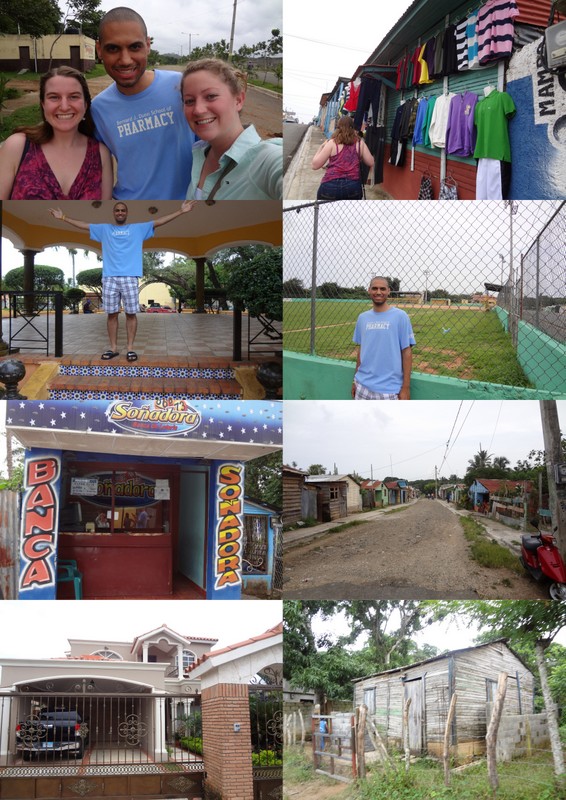
That evening, Liz, Derek and I explored the town. The clinic is about a quarter of a mile outside the main streets of town. The main part of town is filled with people! People were everywhere, walking down the street, shopping, socializing, playing in the park; it was a very happening place on a Friday evening! The main mode of transportation is via motorcycle. They do not wear helmets and they fit as many people as they can on one, including children and infants. It is a bit nerve-racking to see little babies being held on speedy, rickety motorcycle. We saw clothing shops, grocery stores, banks, bancas (equivalent to a lottery shop and are on every street corner), barbershops, ice cream shops, pizzerias, City Hall, churches, murals and lots of stray dogs.

As we explored further and further outside the main streets of the city, you could see the progression of declining wealth. The houses nearest the city proper were concrete, two stories, gated and often had driveways. As we ventured further out, the houses were made out of wood and sheet metal and much smaller. Also many of these homes were off dirt roads that were in bad condition. But the people there seemed happy. They were very friendly, greeted us with a smile and an “hola”, one little girl even said “hi” to us!

Liz, Derek and I adventuring into town!  
On Saturday (6/29), we went for another walk around town, this time exploring the other side. We saw several baseball fields, shops, schools and bancas. We were in search of a real bank, but they appeared to be closed on Saturday, though no hours were posted. While walking, we passed a group of four boys, ages 9-13, and asked them if they like to play baseball and basketball. They told us that they like to play both sports and do karate at the local gymnasium. They were very excited to talk with us…Liz translated, of course! Our walk was cut short as a looming storm that chased us back to the house. It rains here almost every day, but luckily not for too long, showers last anywhere from 10-45 minutes. It is constantly humid and about 85 degrees. My hair really thrives in humidity! (That is a joke for anyone who doesn’t know I have curly, and now really frizzy, hair!)

Exploring more of the city! Pictured are the boys we met outside of the gymnasium. The bottom left is a map of the provinces of the DR painted on the side of a local high school. Bottom right is me standing outside of a local farmacia!
This coming week we will meet with Dana Fitzsimmons, a pharmacist and medical outcomes specialist for Pfizer. Dana spent 4 months between the two Project Hope clinics in 2008. We are excited to meet him! We will let you know what next week has in store for us in our next blog. Until then, adios!

Thursday, June 27, 2013

Bienvenidos a Republicana Dominicana!
6/26 Wednesday

Las Americas International Airport in Santo Domingo

After a relatively short flight from Baltimore Washington International (BWI) to Atlanta and then to Santo Domingo, Jillian and I finally landed at Las Americas International Airport.  The many months of anticipation led us to the beautifully picturesque Dominican Republic.  From BWI, our total flight time was 4 and half hours.

The transition and movement through the airports was seamless. Delta has an app for smartphone users that allows you to check in 24 hours before departure. I'm fairly certain there’s nothing my iPhone can't do at this point. I might just wait until the iPhone 10 comes to the market for pure shock value.

As our last meal before our depart for the Dominican, we decided to have some McDonalds breakfast in Atlanta. You can’t get any more American than that, I thought. In the Dominican, I'd prefer to only experience the local food and try to become fully immersed in the culture.  Perhaps I'll get the chance to show off my very average dance moves as well.

My food was not harmed but stolen for the purpose of taking this photo 

Much of our encounters at the airport were with people inquiring about Project Hope.  We took the time to talk a little about Project Hope and their mission of providing medical care to many underserved regions around the world.  At Las Americas International Airport, we were lucky to find a church group on a mission trip from the Washington D.C who were able to help us through acquiring a tourist visa and getting through customs.  The only drama we encountered at any of the airports was verifying we had our passport and boarding pass. I'm fairly certain that I broke my personal record by rechecking about 92 times.  I had read earlier that it was a custom in the Dominican to clap every time a plane lands safely. This was confirmed when a small cheer with applause began as the wheels of the plane struck the ground.

After clearing customs at Las Americas, we were greeted by Project Hope volunteers Emil and Abdias.  We all then hopped aboard a pickup truck for about an hour ride to the guest house.  Our ride back along the coast of Santo Domingo was incredibly scenic with calm clear waters and numerous palms trees. It began to rain heavily as we departed Santo Domingo and drifted inland towards Monte Plata.


Beautiful coastline waters within close proximity to Las Americas International Airport in Santo Domingo


Considering my Spanish is very limited, I’m glad I was able to converse with Abdias in English and more so in French.  He also speaks Spanish and Haitian Creole.  Abdias is a Medical Student from Haiti who is currently studying in the Dominican Republic.  He will be guiding us and assisting us for the duration of our time at the maternal and pediatric family clinic in Monte Plata. Clinica de Salud Materno Infantil Y Familiar Orden de Malta is our clinic assignment.  We might also spend some time in another clinic in Santo Domingo.  


Chief complaints seen here include tropical diseases (such as dengue fever and parasites), diarrhea, and ear/throat infections.
We'll be discussing health literacy with Dr. Dana Fitzsimmons, a pharmacist and a Medical Outcomes Specialist based in Washington D.C from Pfizer presumably next week. He has taken vacation time to spend a week with us in the Dominican. I can't wait to visit the clinic tomorrow and see what challenges lay ahead. Unlike our friends, Arsen and Tom who visited India, we will fortunately not be experiencing much jet lag.  Same day arrival and no time zone difference! Perhaps Jillian will have to do more internal clock adjustments than me since she recently returned from her first rotation in Arizona. The clinic in Monte Plata is situated on the same grounds where we are staying and we are only a 5-10 minute walk from the town.  It’s an 8 to 5 day work day.

Before signing off for today, I want to thank all involved getting our trip together and the Shenandoah University staff for giving me the opportunity to provide service abroad.  It’s an honor to be able to represent ideals of Project Hope and Shenandoah University in this manner. Lastly, I’d also be remiss if I didn't thank the Sweeney family for letting stay the night due to its close proximity to BWI.  They were kind enough to offer me Maryland style crabs as a farewell meal.  In my almost 3 decades of existence, I can say finally that I finally had crab too. Shocking I know. Thanks.

Jillian and I will try to keep everyone informed of experiences here in Monte Plata and elsewhere. Adios for now.