Hello friends and family,
We have been doing super awesome things, but unfortunately the wifi is not cooperating with posting. SO here it goes, a shortish recap of our adventures.
Our flights were uneventful, but once we got to the airport in Santo Domingo we both realized pretty quickly that we had no idea what we were doing. You are given a bunch of forms to fill out and you need to buy a visa and such. Everything was written in spanish so we were just stumbling along following the crowds, which eventually got us to the right place. Once we got out of the main part of the airport the Project HOPE volunteer director and our preceptor were waiting for us to take us to the hotel, which was a huge help because otherwise we would have been completely lost. The next day we waited at the airport for a while until the navy got a few buses to take us to dock.
The tinder boat ride from the dock to the anchored ship was very exciting. It was rocking and bumping like crazy, and the entire boat had to get lifted up to the main deck of the boat so we could unload. It was such an experience. If I could I would post the pictures, but alas I think the internet would explode if I tried.
The next day we had off to acclimate ourselves to the ship, so we hung around the pharmacy and prepackaged medications for Honduras. Ship life is definitely an adjustment. I never lived in a dorm room in college, but I imagine it is similar to that but with less personal space. Our bunks are tiny, but cozy. After a few days I adjusted and was finally able to sleep. I have also decided I really enjoy not having to cook myself meals everyday. Its quite nice. Being able to call home and talk to my husband everyday has helped with the adjustment too I think, so I am not as homesick as I would be without that wonderful advantage.
The past few days have all been very busy. I have gone out to the med sites 5 times, and 1 day Ryan and I got to go on a SMEE (subject matter expert exchange) to a local hospital and tour the pharmacy. We ended up going to three pharmacies around and eating some delicious local food so that was pretty exciting. The med sites were really hot, but the time flies. I have eaten several MRE's, and am proud to say that I think they are really fun. Its like a fun bag of goodies, and you don't really know what you are going to get. Lunch is always an exciting surprise. They are not nearly as bad as people said they are, although I am sure they get old after so long.
Yesterday we pulled the anchor up and Ryan and I watched from the tippy-top part of the ship (no idea what it is called, I am sure it has a more legitimate name). We are currently in transit from the Dominican Republic to Honduras, and I think we will arrive in a few days. I am hearing that Guatemala was the hottest place, and since Honduras is right there also I am preparing myself for some wicked hot days at the med-sites.
There has been a ton that we have done and learned, and it would take a ton of time to post it all. Ryan and I are having a lot of fun, and we are trying to take advantage of every opportunity that is offered aboard. Hopefully I will be able to post more frequently in Honduras.
Amanda
Monday, August 24, 2015

Sunday, August 16, 2015
First 2 days in Santo Domingo
The first 3 days being on the ship here in Santo Domingo have been pretty decent so far! The meals are not bad (not the greatest thing I have ever eaten either, but nevertheless...). On the 14th we got to meet some of the members of the pharmacy staff on board and they are amazing. I have already become great friends with HN Sparks (from Kentucky) and HM1 Fowler (a good ole guy from Alabama!!) and the best part about meeting these guys is that they LOOOVVVEEE Sweet Tea!!! HN Sparks makes a pitcher of it every day and he found out that I LOOOVVVEEE Sweet Tea too, so he let me partake of some!! Needless to say, my life on the ship is complete now :)
Yesterday, Amanda, Bill, and I got to spend the day in the pharmacy where we pre-packaged some more medication for Honduras. We also found out the actual days we get to go out to the Med-Sites on land, which I got to go out today, then I will go out Wednesday, Thursday, and Saturday.
Today was my first day out at Med-Site #1, which was about 20 minutes from the shore. My preceptor Bill and I were together along with LT Phung, HM3 Aycock, and HM2 Batey. I had to muster at the Pharmacy at 6:15 this morning, then we boarded the tenders to take us to shore around 7:00. So that made us get to the site roughly around 7:30 or 8:00, (after waiting on everyone to make it to shore). Once we started up for the day... the patients came in bursts; sometimes we would get backed up, then we would have 3 to 5 minutes of nothing, then it would get backed up again. The things I saw and the patients I met were eye-opening! A baby less than a year-old with a tumor almost the same-size of its head coming off of its neck and jaw, patients that come up with HIV and you really are not able to give them the meds that they need...
What an experience though!! I can't wait to see how Med-Site #2 goes on Wednesday!
Yesterday, Amanda, Bill, and I got to spend the day in the pharmacy where we pre-packaged some more medication for Honduras. We also found out the actual days we get to go out to the Med-Sites on land, which I got to go out today, then I will go out Wednesday, Thursday, and Saturday.
Today was my first day out at Med-Site #1, which was about 20 minutes from the shore. My preceptor Bill and I were together along with LT Phung, HM3 Aycock, and HM2 Batey. I had to muster at the Pharmacy at 6:15 this morning, then we boarded the tenders to take us to shore around 7:00. So that made us get to the site roughly around 7:30 or 8:00, (after waiting on everyone to make it to shore). Once we started up for the day... the patients came in bursts; sometimes we would get backed up, then we would have 3 to 5 minutes of nothing, then it would get backed up again. The things I saw and the patients I met were eye-opening! A baby less than a year-old with a tumor almost the same-size of its head coming off of its neck and jaw, patients that come up with HIV and you really are not able to give them the meds that they need...
What an experience though!! I can't wait to see how Med-Site #2 goes on Wednesday!
Friday, August 14, 2015
Hi from Santo Domingo!
Hello from Santo Domingo, Dominican Republic...
Amanda and I arrived safely around 12:15am and got to our hotel rooms around 1:15 early this morning. We were, needless to say, extremely exhausted! But, I did get a great night's sleep! We are gonna catch a bite to eat around 9:45, then we are going to head out with a couple other "HOPIES" and pick up a couple other volunteers from another hotel and then we will start boarding the ship around noon. I am so excited and anxious to get started on our mission here!! More to post soon!!
Amanda and I arrived safely around 12:15am and got to our hotel rooms around 1:15 early this morning. We were, needless to say, extremely exhausted! But, I did get a great night's sleep! We are gonna catch a bite to eat around 9:45, then we are going to head out with a couple other "HOPIES" and pick up a couple other volunteers from another hotel and then we will start boarding the ship around noon. I am so excited and anxious to get started on our mission here!! More to post soon!!
Thursday, August 13, 2015
Pictures from Dominica
 |
The area we docked in after we unloaded our cargo. A band from Dominica played at Medsite 1. |
 |
| The water was so clear you could see crabs climbing on the rocks by the pier. |
 |
| The view from the hospital in Roseau. |
 |
| The had medications in Russian. |
 |
| and Arabic. |
 |
| Allyssa and Heather at Medsite 2. |
 |
| Mustering to go to Medsite 2. |
 |
| NGOs at the Dominican Cultural Party. |
 |
| Allyssa, Heather and I at the end of the pier in Dominica. |
Wednesday, August 12, 2015
Introduction
Hello Everyone!
My name is Amanda Shifflett, and I will be traveling with Ryan Garner for the next 4 weeks to the Dominican Republic and Honduras. Hopefully I will be able to post about our adventures on this blog so my friends and family can know how awesome this experience is going to be! A little side note - I am not a blogger. I've never done this before, so we will see how it goes.
I am super pumped to be a part of this mission. Before I started pharmacy school I had a co-worker that was part of Project HOPE. She went to a few countries in the Pacific, and reading her blog posts got me interested. A few years ago I was also fortunate enough to be a part of a different mission trip to Nicaragua for a week, and during then I experienced how rewarding it is to be a part of something so great. It is because of these experiences, along with my deep-seated desire to help people, that I applied for the Project HOPE rotation.
I will start off by saying that I am very nervous. I have never been on a ship before, and the longest I have been away from my husband and puppy is one week, so it is certainly going to be difficult (I also have no idea how the ham to pack for an entire month). However, I am sure it is going to be incredibly rewarding!
We leave for the airport tomorrow afternoon, and we will meet up with the navy ship on Friday. I am told that the wifi on board is very sketchy, but I hope to be able to post something after Sunday. Goodbye for now.
My name is Amanda Shifflett, and I will be traveling with Ryan Garner for the next 4 weeks to the Dominican Republic and Honduras. Hopefully I will be able to post about our adventures on this blog so my friends and family can know how awesome this experience is going to be! A little side note - I am not a blogger. I've never done this before, so we will see how it goes.
I am super pumped to be a part of this mission. Before I started pharmacy school I had a co-worker that was part of Project HOPE. She went to a few countries in the Pacific, and reading her blog posts got me interested. A few years ago I was also fortunate enough to be a part of a different mission trip to Nicaragua for a week, and during then I experienced how rewarding it is to be a part of something so great. It is because of these experiences, along with my deep-seated desire to help people, that I applied for the Project HOPE rotation.
I will start off by saying that I am very nervous. I have never been on a ship before, and the longest I have been away from my husband and puppy is one week, so it is certainly going to be difficult (I also have no idea how the ham to pack for an entire month). However, I am sure it is going to be incredibly rewarding!
We leave for the airport tomorrow afternoon, and we will meet up with the navy ship on Friday. I am told that the wifi on board is very sketchy, but I hope to be able to post something after Sunday. Goodbye for now.
Thursday, August 6, 2015
Dominica
Like Heather said earlier, the WIFI on the ship has been out for most of the time that we have been in Dominica and I didn't want to drag my computer down into town to use the internet at a restaurant to post a blog.
Dominica has been much easier than Colombia just in travel alone. We got to be pier side here so that meant no tinder rides, which is great for my motion sickness. We did have an hour van ride to Medsite 2, but that was still better than the up to 3 hour boat rides from Colombia. Another benefit of being pier side is that we got to have some liberty when we were not working. That meant meals not from the mess decks and some time to wander around Roseau.
The first day after set up, I went out to Medsite 1 which was a few blocks from where the boat was docked in Roseau. They had not been able to set up the pharmacy the day before because of surgical screening so we had to set up pharmacy and get ready for patients relatively quickly. The people who had been there before told us that the pharmacy was going to be small, but I did not expect it to be as small as it was. We could barely fit the 5 of us and all the medications into the room, much less patients in there to pick up their medications. So, I was given door duty for the day. That meant I had to get the forms from the patients when the came to the pharmacy, make sure they did not come in the door, and then counsel them when the medications were ready. That made for a busy day because the patients really wanted to come into the pharmacy and see what was going on.
The next day Heather and I went to Princess Margaret Hospital on a SMEE. We got to see how the hospital was set up as well as how they run their pharmacy.
I spent the next 2 times that I was out at Medsite 2 which was in Portsmouth. We had an hour van ride there on a coastal road, that we learned was built by the Chinese government. The pharmacy at Medsite 2 was super spacious compared to Medsite 1.
I had one more day at Medsite 1 and then was off the last 2 days we were here. I got to spend some time exploring the small area in Roseau that we were allowed to wander around before we pulled out tonight.
We get to Barbados tomorrow and will fly out the next day.
I will post pictures on Dominica when we get back to the land of relatively fast internet.
I can't believe that our 5 weeks here are already over.
Dominica has been much easier than Colombia just in travel alone. We got to be pier side here so that meant no tinder rides, which is great for my motion sickness. We did have an hour van ride to Medsite 2, but that was still better than the up to 3 hour boat rides from Colombia. Another benefit of being pier side is that we got to have some liberty when we were not working. That meant meals not from the mess decks and some time to wander around Roseau.
The first day after set up, I went out to Medsite 1 which was a few blocks from where the boat was docked in Roseau. They had not been able to set up the pharmacy the day before because of surgical screening so we had to set up pharmacy and get ready for patients relatively quickly. The people who had been there before told us that the pharmacy was going to be small, but I did not expect it to be as small as it was. We could barely fit the 5 of us and all the medications into the room, much less patients in there to pick up their medications. So, I was given door duty for the day. That meant I had to get the forms from the patients when the came to the pharmacy, make sure they did not come in the door, and then counsel them when the medications were ready. That made for a busy day because the patients really wanted to come into the pharmacy and see what was going on.
The next day Heather and I went to Princess Margaret Hospital on a SMEE. We got to see how the hospital was set up as well as how they run their pharmacy.
I spent the next 2 times that I was out at Medsite 2 which was in Portsmouth. We had an hour van ride there on a coastal road, that we learned was built by the Chinese government. The pharmacy at Medsite 2 was super spacious compared to Medsite 1.
I had one more day at Medsite 1 and then was off the last 2 days we were here. I got to spend some time exploring the small area in Roseau that we were allowed to wander around before we pulled out tonight.
We get to Barbados tomorrow and will fly out the next day.
I will post pictures on Dominica when we get back to the land of relatively fast internet.
I can't believe that our 5 weeks here are already over.
Friday, July 31, 2015
Continuing Promise 2015: Doh-mah-nee-kah
WiFi on the ship has been down for the past week and will be for the foreseeable future as someone plugged their laptop into the router in the middle of the night and hacked the password...now the seabees have to build a box to lock around the router so it doesn't happen again...they are busy out at site building ramps...
I'm currently out in Dominica enjoying a nice breakfast with good coffee...not galley sludge...Esther and I were able to get an early special liberty since usually we can't go out until after duty hours (1600-2030)...
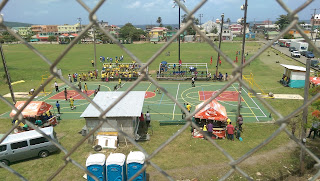
Since arriving in Dominica on Monday July 27th I went out to site #2 on Tuesday which was an hour bus ride along the coast...this site was also at a school that is open air but we had a spacious room and lights and a fan...the best site since the mission has started...that's not say it's not without its challenges but the patients speak English with a few pockets of Creole so there was no need for translators...all the patients were very friendly and there was even a sports tournament going on...I believe its called the windward games...it's the 4 neighboring Caribbean islands that compete in basketball,volleyball, futbol, etc...
the navy band was also on site for a little bit...

The next day (Wednesday 28th) Emily and I were able to attend a SMEE at Princess Margaret Hospital with LT Phung and HM3 Fowler...we took a tour of the hospital which was also open air...it's a very weird feeling seeing that after going to the OR which is basically an upgraded double wide trailer the patient is wheeled outside across to the PACU...all the wards were big open bays full of those old school shopping cart like meds...like the kind you see watching the Pearl Harbor/ any WWII movie...everything they do is handwritten and there are only 4 pharmacists and 1 tech for around 260 bed so they do not have time to actually do their job they spend it handwriting labels and logs...we spent time explaining how to go about installing the laminar flow hood they acquired...they did not have a hood for inpatient IVs the nurse does it on the floor....we ended the day seeing a man who just died...a man we had seen within the past 30mins alive in the hallway...being wheeled on a gurney through the crowd uncovered...a patient had bled all over the floor so they almost slipped....another aspect that was interesting was that a peds surgery patient who was around 7yrs old was all alone...I think it would be rare in the states to have your child in the hospital and not be by their bedside...
Wrote this from my cell phone at the Fort Young hotel....all is well and I will upload more if the Wi-Fi comes up on the ship otherwise I will post a final blog once we land in Barbados
I'm currently out in Dominica enjoying a nice breakfast with good coffee...not galley sludge...Esther and I were able to get an early special liberty since usually we can't go out until after duty hours (1600-2030)...
Since arriving in Dominica on Monday July 27th I went out to site #2 on Tuesday which was an hour bus ride along the coast...this site was also at a school that is open air but we had a spacious room and lights and a fan...the best site since the mission has started...that's not say it's not without its challenges but the patients speak English with a few pockets of Creole so there was no need for translators...all the patients were very friendly and there was even a sports tournament going on...I believe its called the windward games...it's the 4 neighboring Caribbean islands that compete in basketball,volleyball, futbol, etc...

the navy band was also on site for a little bit...

The next day (Wednesday 28th) Emily and I were able to attend a SMEE at Princess Margaret Hospital with LT Phung and HM3 Fowler...we took a tour of the hospital which was also open air...it's a very weird feeling seeing that after going to the OR which is basically an upgraded double wide trailer the patient is wheeled outside across to the PACU...all the wards were big open bays full of those old school shopping cart like meds...like the kind you see watching the Pearl Harbor/ any WWII movie...everything they do is handwritten and there are only 4 pharmacists and 1 tech for around 260 bed so they do not have time to actually do their job they spend it handwriting labels and logs...we spent time explaining how to go about installing the laminar flow hood they acquired...they did not have a hood for inpatient IVs the nurse does it on the floor....we ended the day seeing a man who just died...a man we had seen within the past 30mins alive in the hallway...being wheeled on a gurney through the crowd uncovered...a patient had bled all over the floor so they almost slipped....another aspect that was interesting was that a peds surgery patient who was around 7yrs old was all alone...I think it would be rare in the states to have your child in the hospital and not be by their bedside...
Wrote this from my cell phone at the Fort Young hotel....all is well and I will upload more if the Wi-Fi comes up on the ship otherwise I will post a final blog once we land in Barbados
Subscribe to:
Posts (Atom)